
If you are getting ready to stain a deck this season in Sheboygan, the process matters more than most people expect. One wrong step, whether staining wet wood, skipping prep, or picking the wrong temperature window, and the finish peels before the first winter is over. Knowing the best way to stain a deck from the start saves you a full redo in a year or two.
Key Takeaways
- Prep work, not the stain itself, is what determines how long the finish lasts.
- Wisconsin’s freeze-thaw cycle makes moisture protection non-negotiable.
- The water bead test tells you whether wood is ready to accept stain.
- Temperature and humidity windows matter as much as your product choice.
- New decks and old decks call for different preparation approaches.
- A professional application can outlast multiple rounds of DIY work.
Why Deck Staining Matters More in Wisconsin
Sheboygan-area homeowners deal with a climate that is genuinely hard on wood. Weeks of below-zero temperatures, repeated freezing and thawing, heavy snowfall, and humid summers all compound on outdoor structures over time. Without a protective barrier, wood absorbs moisture and constantly expands and contracts with temperature swings, which leads to warping and cracking.
Stain is what stands between your deck and that breakdown cycle. It works like a sealant, clogging the wood’s pores and making the surface hydrophobic so it repels water and the debris that comes with it. Because stains are pigmented, they also add color and shield against UV damage while providing moderate moisture protection.
Skip the stain long enough and it wears off, letting water reach the wood and cause mold or rot. In a Wisconsin winter, that moisture can freeze inside the wood and cause splitting that goes well beyond the surface.
The Best Way to Stain a Deck Starts With an Honest Inspection
Before anything touches the wood, walk the entire surface. Look for broken or uneven boards, raised nails or screws, pooled-water areas, mildew, or algae buildup.
Wood rots when exposed to moisture, and depending on the deck’s age, that rot can be extensive. Rotted wood cannot be stained, since it will not hold the finish and will not last.
Fix loose fasteners, replace rotted or broken boards, and fill significant cracks with epoxy putty before anything else. Handling these structural issues first means you are staining a solid, stable surface instead of covering up problems.
One critical check on new decks: treated lumber is protected from the elements but is usually too wet to stain right away, and some boards carry a glossy mill glaze that has to be removed. Run the water bead test to confirm readiness: if water beads on the surface, the wood is not ready, and if it absorbs quickly, the wood is ready for cleaning and staining. This simple test saves homeowners a lot of frustration.
Clean the Deck Thoroughly, This Step Decides Everything
Cleaning is the most important step in staining, because a clean surface lets the stain soak in and cure. Dirt, mildew, grease, and old failing stain all act as barriers between the new finish and the wood, so staining over them bonds the finish to contamination instead of wood, and it fails early. A clean surface is the real foundation of the best way to stain a deck.
For a deck with light weathering and no prior solid stain, a thorough pressure wash followed by a deck brightener is often enough. If you use a power washer, choose a PSI of 1,200 to 1,400 with a 45° tip, and spray along the wood grain to avoid damaging the surface. Our pressure washing guide covers technique in more detail.
For a deck with old peeling stain or paint, the prep is more involved, and the previous finish has to come off completely with chemicals and sanding. Skip stripping and the new stain sits on the surface, causing flashing and a patchy look. Many of the same surface-prep mistakes sink paint jobs too, which our post on why DIY exterior paint jobs fail walks through.
After any chemical cleaner, a wood brightener restores the wood’s natural pH and opens the pores to accept stain more evenly. Let the deck dry completely before applying anything, since stain on damp wood will not adhere and can crack or peel. Waiting at least 48 hours after cleaning is a reliable rule in Wisconsin’s variable weather.
Picking the Right Stain Type for Your Deck
Not all stains are equal, and the right choice depends on your deck’s condition and how much maintenance you want going forward.
Transparent Stains
Transparent stains let the wood grain show but need the most upkeep, generally requiring reapplication every year. They fit a new deck with attractive grain you want to showcase.
Solid or Opaque Stains
Solid or opaque stains cover the natural grain but typically last 3 to 5 years before a new coat. They work well on older decks where weathering or inconsistency is something you would rather not highlight.
Semi-Transparent Stains
Semi-transparent stains fall in between, adding color while still letting some character show through. For most Sheboygan decks that have seen a few Wisconsin winters, semi-transparent or solid stains offer a practical balance of protection and appearance.
It is also worth weighing water-based against oil-based. Water-based stains dry faster and have less odor, while oil-based stains penetrate deeper and last longer, which tends to perform well in high-moisture climates, though modern water-based formulas have closed much of that gap.
If you are covering a large area with multiple cans, mix them together first to keep color consistent and avoid subtle shade differences once dry. If a bolder look is what you are after, our guide on bold fence color ideas shows how color choices play out on exterior wood.
Timing and Temperature: When to Stain in Wisconsin
Timing is one area where Wisconsin homeowners need to be especially careful. The best window to stain decks in northern Wisconsin runs from late spring into early fall. Aim for 50°F daytime lows up to 90°F highs, and know that stain cannot drop below 40°F during a 24-hour cure or it will not bond correctly.
Most stains apply from about 50°F to 90°F, but that range refers to the temperature of the wood surface, not just the air. A 70°F sunny day can push deck surface temperatures above 90°F, which creates application problems.
Above 90°F, stain dries too fast and penetrates poorly, leaving an uneven finish, while high humidity slows drying and hurts adhesion. Wet wood causes peeling, and direct sun accelerates drying and disrupts even penetration.
The practical takeaway is to aim for a cloudy or overcast morning with no rain in the 48-hour forecast. That combination gives you the best chance at an even finish that penetrates fully before the sun or a cold snap interferes.
How to Apply the Stain the Right Way
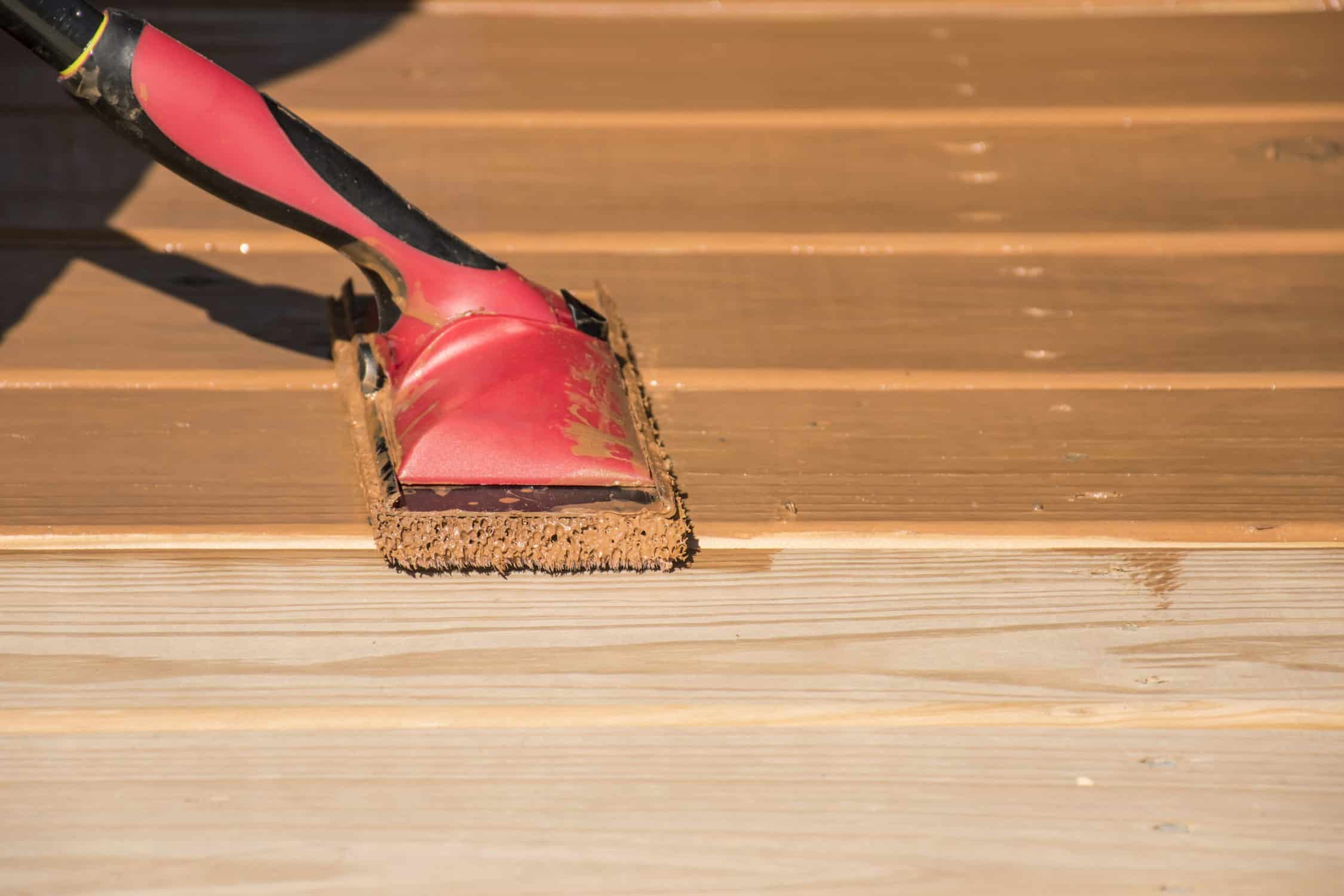
Start with the vertical sections, the railings, posts, and balusters, before touching the deck surface, working top down with a brush in long, even strokes. Cover any adjacent siding or landscaping with painter’s tape and drop cloths. The best way to stain a deck is to work in this order so you are never fighting drips onto finished boards.
For the deck boards, use a roller for fast coverage, then brush into all cracks and grooves with a quality brush. Always follow a roller or pad with a brush to work stain into the wood, a step called back-brushing, which is best done with a partner to avoid lap marks and uneven streaks.
Plan your exit before you start, deciding where you will begin and end so you always have a path off the deck without stepping on wet stain.
Keep in mind that more stain is not better. Over-applying can cause peeling or cracking when moisture hits, or leave a sticky surface that will not dry, since thin, even coats absorb properly and heavy pooling does not. Once the first coat is down, let it dry at least 24 hours before considering a second, and check the label, because some penetrating stains are made for a single coat and a second can actually cause peeling.
How Often Should You Restain a Deck in Sheboygan?
There is no single answer, but a simple rule applies: spray a bit of water on the deck and watch. If the drops bead up, the stain is still repelling moisture and you likely have more time, and if the water soaks in quickly, the wood is absorbing moisture unprotected, so it is time to restain.
Transparent stains may need refreshing every 1 to 2 years in Wisconsin conditions, while solid stains on a well-prepped surface can last 3 to 5 years. Skipping the maintenance window costs more in the long run, since a deck that rots from neglect often needs full board replacement rather than a simple recoat. Staying on that window is part of the best way to stain a deck for the long haul, and our guide on deck and fence maintenance covers ongoing care.
When the Job Is Better Left to a Professional
Some decks are straightforward. Others are not. Restoring a deck means knowing which chemicals remove which finishes, how strong they are, the right dwell times, the expected result, when to use brighteners, and how to sand afterward, which is hard experience to build on a single weekend.
If your deck has multiple layers of old solid stain, significant rot, or boards from before 2004 that may have been treated with chromated copper arsenate (CCA), those situations call for a professional evaluation before any work begins. On older CCA decks, the EPA notes that a regularly applied penetrating stain can actually reduce the leaching of those chemicals, which is one more reason to get the prep and product right.
Our post on when to call a restoration specialist covers the decision in detail and is worth reading before committing to a large deck project on your own.
What You Get When S&S Painting & Restoration Handles It
Bob Scherer Sr. and Bob Scherer Jr. run S&S Painting & Restoration as a father-son team, so the owners are on the job, not managing it from a distance. The team is factory trained by Sherwin-Williams and holds active membership in the Painting Contractors Association (PCA), which keeps their products and techniques current rather than guesswork.
For Sheboygan homeowners, that matters. Getting the best way to stain a deck right in this climate means reading the weather, knowing the products, and doing the prep most people want to skip, and when those steps are done correctly, a properly stained deck holds up through Wisconsin winters and looks good doing it. If you are tackling other exterior wood at the same time, our posts on exterior house painting and the best paint for gutters and fascia cover adjacent surfaces that often need attention alongside a deck.
Ready to stop guessing and get a result that actually holds up? The season for exterior work in Sheboygan moves fast, so reach out before the best weather windows close. Call 920-332-5772 for a FREE estimate today.